A. Suneetha is an independent scholar based in Hyderabad. She has recently co-edited a volume of essays, Faith in Democracy: Muslim Political Discourse in the Telugu Region. Shaik Mahaboob Basha is Associate Professor of History, Centre for Distance and Online Education (CDOE), Maulana Azad National Urdu University, Hyderabad, Telangana.
Suneetha: Congratulations on the publication of your new book, Scripting a New Gender Politic: Telugu Women’s Journals 1883-1960. Your history revisits the narrative of ‘social reform’ in the Telugu country from the perspective of female activism. Why did you think it was necessary to go back to this movement?
Basha: The dominant understanding of the social reform movement is that it receded as the Indian nationalist movement accelerated at the turn of the twentieth century. Women’s journals show us an entirely different picture. They attest to the fact that social reform reached its peak during the early twentieth century precisely because of women’s involvement in it.
This was an important shift in the movement – women’s issues went from being their issues to our issues. For men, it was a matter of their issues and national issues – women were a scale to measure the status of the nation. For women, it was a matter of our issues which were to be solved primarily with our own efforts. This understanding is especially conspicuous in women’s writings and their speeches delivered at regularly conducted women’s conferences.
Telugu women’s journals in the colonial period narrate the story of a strong women’s movement. A careful reader of these journals will find the pre-history of a number of contemporary feminist concerns in them.
Suneetha: How do you define ‘women’s journals?’ When and how did the first Telugu women’s journal begin?
Basha: Women’s journals are journals that primarily discussed woman-centric issues and meant for women readers. They were initially started by male social reformers.
The first Telugu women’s journal was Sathihihta Bodhini (1883–1904). Its founder and editor was Kandukuri Veeresalingam, often called the father of Telugu social reform. It began publication in 1883 as a monthly from Rajahmundry – an important center of colonial education and the nucleus of social reform in Andhra.
Telugu Zenana, December 1894
The second Telugu women’s journal was Telugu Zenana (1893–1907). Sathihitha Bodhini actually merged with this journal in 1904. Telugu Zenana was edited by Rayasam Venkata Sivudu, another prominent male social reformer.
Apart from its rich contributions to male-initiated projects of social reform, Telugu Zenana is important for modern Telugu literary history. It was the first journal to publish short stories by the early feminist writer, Bhandaru Atchamamba. Many people know Atchamamba from her pioneering collection of women biographies, Abala Saccharitra Ratnamala (1901).
Suneetha: How and when did women begin to edit these journals? What perspectives did they adopt?
Basha: The first Telugu women’s journal edited by a woman was Hindu Sundary (1902–1960). The history of this journal interesting. It was also founded by a man, Sattiraju Sitaramaiah. He tried his best to recruit a woman as his editor but everyone he initially approached declined his offer.
Mosalikanti Ramabayamma, Editor of Hindu Sundary
A year after its founding, he hastily roped in two women – Mosalikanti Ramabayamma and Vempali Shantabayamma – as editors for Hindu Sundary. This was in December 1903. He was in a rush because Pulugurta Lakshmi Narasamamba had announced she was launching her own Telugu women’s monthly, Savithri, in January 1904.
Savithri was a socially conservative journal. Its editor, Lakshmi Narasamamba, was intensely opposed the widow remarriage movement. In her view, widow remarriage amounted to ‘prostitution’ because Hindu women should only have one husband – whether alive or dead. Death did not make a woman single. She believed a widow who remarried could not be considered a ‘kulaangana’ (chaste wife/woman).
Women’s journals reveal a protracted war among Telugu women activists on place of remarried widows in the movement. They debated whether to invite remarried widows to women’s conferences and whether they could be treated as respectable ‘kulaanganas.’ This led to a split in the famous women’s organization Sri Vidyarthini Samajamu of Kakinada. That fascinating story cannot be retold here – but you can read it in the book!
Suneetha: Can you tell us about some of the women editors and activists you encountered in these journals?
Basha: There are too many to focus on! But I can give Maidaanam a short list of a few women who were important to my project.
Mosalikanti Ramabayamma – She was a relentless campaigner against the custom of widow head shaving. She termed this a ‘horrendous’ and ‘barbaric’ practice, mobilised women against it, and submitted a mahzar (opinion) to the British Government in the first decade of the 20th century.
Yellapragada Sitakumari – She was one of the founders of the ‘Andhra Yuvati Mandali’ in Hyderabad in 1935. She presided over the third Nizam Rashtraandhra Mahila Mahasabha conference.
Chimakurti Satyavati Devi – She was a child-bride who was married to Chimakurti Basavaiah Shresthi (Vaishya caste). She married at nine years old and was never formally educated. A self-taught but highly accomplished scholar, she presided over several women’s conferences. Her grandfather is the veteran non-Brahmin leader Atmuri Lakshminarasimha Somayaji.
V. Saraswati – A completely forgotten feminist. She was a writer and activist in the colonial period and especially important for her debate with Bangalore Nagarathnamma on the mentality of men.
Suneetha: What are some of the important journals you discuss in your book?
Basha: There were about twenty-five women’s journals published in colonial Andhra. A few of them continued beyond 1947. Some of the more important journals are Vivekavathi (1909–1934; a Christian Missionary women’s journal), Anasuya (1917–1924), Andhra Lakshmi (1921–1924), Grihalakshmi (1928–1961), and Andhra Mahila (1944–beyond 1964). Vanita, edited by the well-known writer Abburi Chayadevi, began publishing in 1956.
Suneetha: How did concerns around social reform change with the entry of women? Can you give us an example?
Basha: Let us take the issue of education. Initially, all (both men and women) argued that women needed to be educated. Men wanted better wives, not ‘beasts’ who grew up in the wilderness of ignorance. They wanted women who would not frustrate the Romantic aspirations of their personal lives. Most of these gentlemen had studied Romantic literature in English schools and colleges and found Romantic love utterly lacking in their daily family lives. They also thought wives could support their husbands in with their social activism.
Early women reformers – say for example Bhandaru Atchamamba – also argued that, if educated, they would prove to be better wives, better mothers, better daughters-in-law, better neighbours, etc. Women would become constructive, civilised, and ‘socially useful’ individuals. They would avoid cheap gossip with neighbouring women (poruginti ammalakkalu). So, there was a war cry for women’s education to improve women’s behavior.
Once the need for women’s education became generally agreed on, pro-women’s education people started debating the kind of education women should receive. They discussed whether the curriculum of boys and girls should be the same and whether women should aspire for higher education, etc. While it is difficult to say with precision, it may be said that this discussion largely started in the second decade of the twentieth century.
But it was not until the forties that some writers started regularly arguing that one’s choice, not one’s gender, should determine educational tracks: if a boy wanted to choose cooking as his profession, he should have the choice to get the kind of education required for the job; similarly, if a girl wanted to join the army, she should have the choice to receive suitable education.
Suneetha: When did women writers, activists, and reformers begin to question social double standards and male dominance?
Chimakurti Satyavati Devi
Basha: By the 1920s, women had begun to boldly accuse men. They held them responsible for their dismal conditions. Most importantly, they demanded that men must become patnivratas (devoted to wives).
Women intellectuals like Chimakurti Satyavati Devi said that men have always tutored women to become pativratas (devotees of husbands) and published a large number of books, including ‘canonical texts.’ She forcefully argued that now it was the time for men to become patnivratas.
In 1929, a feminist named V. Saraswati demanded that men grant ‘freedom’ to women. She wrote: “Is it not strange that Indian men, who are fighting for freedom from the British, are not willing to grant the same to women, who constitute 50% of the Indian population?”
She believed that Indian men should give full freedom to Indian women before asking for the same from the British. She cursed them saying that if men did not do that, they would never get freedom. At another place, while she was engaged in a debate with Bangalore Nagarathnamma, V. Saraswati declared that ‘Indian men, or for that matter, all men in the world were selfish’.
Like this, one finds women discussing a number of issues in women’s journals: not just their civil and political rights but also their social conditions – the ‘energy-sapping’ kitchen, ‘thankless’ domestic labour (often described as vetti i.e. customary forced labor), the burden of childrearing falling solely on women, and husbands who were insensitive, cigarette-smoking, and money-wasting etc.
“Vidyapriyulu” (Lovers of Learning) Grihalakshmi , 1929
Suneetha: So, women moved from being the object of male benefaction to having their own voice in the 1920s?
Basha: The issue of husbands giving ‘salaries’ to their wives was discussed in the late 1930s. As we know, in 2012, the Ministry of Women and Child Welfare, Government of India, seriously considered this plan as a marker of recognition to women’s domestic labour.
Yellapragada Sitakumari rubbished such plans to be the ‘conspiracy of men.’ She asked many apposite questions: who would give salaries to single, separated, and widowed women? It was possible for an employee to change her employer if she was not satisfied with her salary offered or continue in a job. ‘But could a wife change her husband if she was not satisfied with the salary he offered or if she did not like him?’ Sitakumari asked these questions when the notion of divorce for Hindu women was still in its infancy.
Similarly, one comes across short stories such as ‘Vanta Yevaru Cheyyali?’ (‘Who Should Cook?’) by Sarojini Devi. ‘Godraalu’ (Infertile Woman) is a powerful short story that questions deep-seated stereotypes with regard to women and motherhood.
Suneetha: How does caste appear in these journals and the social reform organizations that published them?
Basha: Caste appears very clearly. The women’s journals I studied are openly ‘upper’ caste-oriented in character. They were particularly dominated by Brahmin women. Almost all the editors of the women’s journals belong to the Brahmin caste. Most of the contributors, especially in the initial phase, were also ‘pure vegetarian’ Brahmins.
A number of non-Brahmin women also contributed to the journals although their number was less. Within the non-Brahmin segment, Vaishya women had a stronger presence followed by Kammas and Reddys. There were very few Dalit women. The women’s journals did feature Dalit women who accomplished something in terms of education and public life. In Vivekavathi, one comes across a number of Christian women writers but I cannot confirm they are Dalit Christians.
At least a few of the ‘progressive’ upper caste women used caste status to threaten their caste-women. For example, when they wanted to convince them about the importance of women’s education, they usually pointed to the Christian (including Dalit Christian) and Shudra women, who passed higher examinations, and threatened that if ‘our Brahmin’ girls, who possessed superior mental faculties, did not study, they would lag behind their social inferiors. Thus, the fear of losing status was successfully injected and a kind of caste-competition was promoted.
There were a few women’s organisations like the Sri Vidyarthini Samajamu (Kakinada) mentioned above that explicitly excluded members by caste. Its bylaws debarred Dalit women from becoming members. At the same time, we see that this caste arrogance did not go unquestioned, especially by Shudra women like Kalagara Pichchamma and Kalagara Ramamma.
Members of the Sri Vidyarthini Samajamu, Mahila Vidyalayamu, Hindu Sundary, and Srirajya Lakshmi Pustaka Bhandagaramu (Source: Grihalakshmi, 1934)
Suneetha: In the light of these caste dynamics, do you think the social reform initiatives promoted in women’s magazines have a relevance for the broader public? Or are they simply limited to some groups?
Basha: The education campaign that Telugu women launched was for all women. They campaigned against child marriage practised by all castes (in varying degrees), including Shudras and Dalits.
Even before Gandhi’s appeal for a humane treatment of the Dalits, Telugu women’s journals tried to sensitise society towards the problems of ‘untouchables.’ This is why we regularly find articles by upper caste women condemning untouchability. Yet, most of them also felt that treating Dalits with respect or allowing them to draw water from their wells was some kind of charity. In this regard, the language of rights had yet to enter their minds.
Suneetha: There is a popular idea that Hindus welcomed social reforms while Muslims remained conservative. Does your study of Telugu women’s magazines give us any clarity about this?
Basha: This is difficult to answer based on my study. I could find only a negligible number of Muslims in Telugu women’s journals. Interestingly, I did find many male Muslim names in the subscribers’ lists.
I discovered a short story by S.M. Akbar that criticized the practice of Burqa/Purdah. This was published in Grihalakshmi in the 1930s. I take this to mean that if there were people who wanted to discuss Muslim issues, Telugu women’s journals welcomed them.
There were a few other Muslim women and men who occasionally appeared in their pages – S. Nanni Begum, Saleema Begum, etc. The latter, based in Madanapalli in Rayalaseema, was active in the women’s movement.
Suneetha: One striking feature about your book is that it breaks the invisible line of 1947. Historians take this as a sacrosanct boundary – most research focus either before or after Indian independence. Why did you think it was necessary for your history to bridge the colonial and post-colonial periods?
“Prabhutvamu-Strila Yabhivriddhi” (The Government and Women’s Development), Grihalakshmi, 1929
Basha: Women’s journals show us that many women shared a perception that men might cheat them out of the fruits of their joint struggle for independence. This perception only became stronger after 1947.
It was believed that something very big would take place after independence. Many women were disappointed to find that that these ‘big’ things were nowhere to be seen in Government policy or even society at large.
So, women naturally felt that the social reform movement, under their own leadership, must continue. As per available evidence, we find that it continued well beyond the ‘magical’ boundary of 15 August 1947. There was still much work to do.


Editor’s Note: In the following discussion, A. Suneetha interviews Shaik Mahaboob Basha about his recent publication, Scripting a New Gender Politic: Telugu Women’s Journals 1883-1960 (Orient Blackswan, 2025).
A. Suneetha is an independent scholar based in Hyderabad. She has recently co-edited a volume of essays, Faith in Democracy: Muslim Political Discourse in the Telugu Region. Shaik Mahaboob Basha is Associate Professor of History, Centre for Distance and Online Education (CDOE), Maulana Azad National Urdu University, Hyderabad, Telangana.
Suneetha: Congratulations on the publication of your new book, Scripting a New Gender Politic: Telugu Women’s Journals 1883-1960. Your history revisits the narrative of ‘social reform’ in the Telugu country from the perspective of female activism. Why did you think it was necessary to go back to this movement?
Basha: The dominant understanding of the social reform movement is that it receded as the Indian nationalist movement accelerated at the turn of the twentieth century. Women’s journals show us an entirely different picture. They attest to the fact that social reform reached its peak during the early twentieth century precisely because of women’s involvement in it.
This was an important shift in the movement – women’s issues went from being their issues to our issues. For men, it was a matter of their issues and national issues – women were a scale to measure the status of the nation. For women, it was a matter of our issues which were to be solved primarily with our own efforts. This understanding is especially conspicuous in women’s writings and their speeches delivered at regularly conducted women’s conferences.
Telugu women’s journals in the colonial period narrate the story of a strong women’s movement. A careful reader of these journals will find the pre-history of a number of contemporary feminist concerns in them.
Suneetha: How do you define ‘women’s journals?’ When and how did the first Telugu women’s journal begin?
Basha: Women’s journals are journals that primarily discussed woman-centric issues and meant for women readers. They were initially started by male social reformers.
The first Telugu women’s journal was Sathihihta Bodhini (1883–1904). Its founder and editor was Kandukuri Veeresalingam, often called the father of Telugu social reform. It began publication in 1883 as a monthly from Rajahmundry – an important center of colonial education and the nucleus of social reform in Andhra.
The second Telugu women’s journal was Telugu Zenana (1893–1907). Sathihitha Bodhini actually merged with this journal in 1904. Telugu Zenana was edited by Rayasam Venkata Sivudu, another prominent male social reformer.
Apart from its rich contributions to male-initiated projects of social reform, Telugu Zenana is important for modern Telugu literary history. It was the first journal to publish short stories by the early feminist writer, Bhandaru Atchamamba. Many people know Atchamamba from her pioneering collection of women biographies, Abala Saccharitra Ratnamala (1901).
Suneetha: How and when did women begin to edit these journals? What perspectives did they adopt?
Basha: The first Telugu women’s journal edited by a woman was Hindu Sundary (1902–1960). The history of this journal interesting. It was also founded by a man, Sattiraju Sitaramaiah. He tried his best to recruit a woman as his editor but everyone he initially approached declined his offer.
A year after its founding, he hastily roped in two women – Mosalikanti Ramabayamma and Vempali Shantabayamma – as editors for Hindu Sundary. This was in December 1903. He was in a rush because Pulugurta Lakshmi Narasamamba had announced she was launching her own Telugu women’s monthly, Savithri, in January 1904.
Savithri was a socially conservative journal. Its editor, Lakshmi Narasamamba, was intensely opposed the widow remarriage movement. In her view, widow remarriage amounted to ‘prostitution’ because Hindu women should only have one husband – whether alive or dead. Death did not make a woman single. She believed a widow who remarried could not be considered a ‘kulaangana’ (chaste wife/woman).
Women’s journals reveal a protracted war among Telugu women activists on place of remarried widows in the movement. They debated whether to invite remarried widows to women’s conferences and whether they could be treated as respectable ‘kulaanganas.’ This led to a split in the famous women’s organization Sri Vidyarthini Samajamu of Kakinada. That fascinating story cannot be retold here – but you can read it in the book!
Suneetha: Can you tell us about some of the women editors and activists you encountered in these journals?
Basha: There are too many to focus on! But I can give Maidaanam a short list of a few women who were important to my project.
Mosalikanti Ramabayamma – She was a relentless campaigner against the custom of widow head shaving. She termed this a ‘horrendous’ and ‘barbaric’ practice, mobilised women against it, and submitted a mahzar (opinion) to the British Government in the first decade of the 20th century.
Yellapragada Sitakumari – She was one of the founders of the ‘Andhra Yuvati Mandali’ in Hyderabad in 1935. She presided over the third Nizam Rashtraandhra Mahila Mahasabha conference.
Chimakurti Satyavati Devi – She was a child-bride who was married to Chimakurti Basavaiah Shresthi (Vaishya caste). She married at nine years old and was never formally educated. A self-taught but highly accomplished scholar, she presided over several women’s conferences. Her grandfather is the veteran non-Brahmin leader Atmuri Lakshminarasimha Somayaji.
V. Saraswati – A completely forgotten feminist. She was a writer and activist in the colonial period and especially important for her debate with Bangalore Nagarathnamma on the mentality of men.
Suneetha: What are some of the important journals you discuss in your book?
Basha: There were about twenty-five women’s journals published in colonial Andhra. A few of them continued beyond 1947. Some of the more important journals are Vivekavathi (1909–1934; a Christian Missionary women’s journal), Anasuya (1917–1924), Andhra Lakshmi (1921–1924), Grihalakshmi (1928–1961), and Andhra Mahila (1944–beyond 1964). Vanita, edited by the well-known writer Abburi Chayadevi, began publishing in 1956.
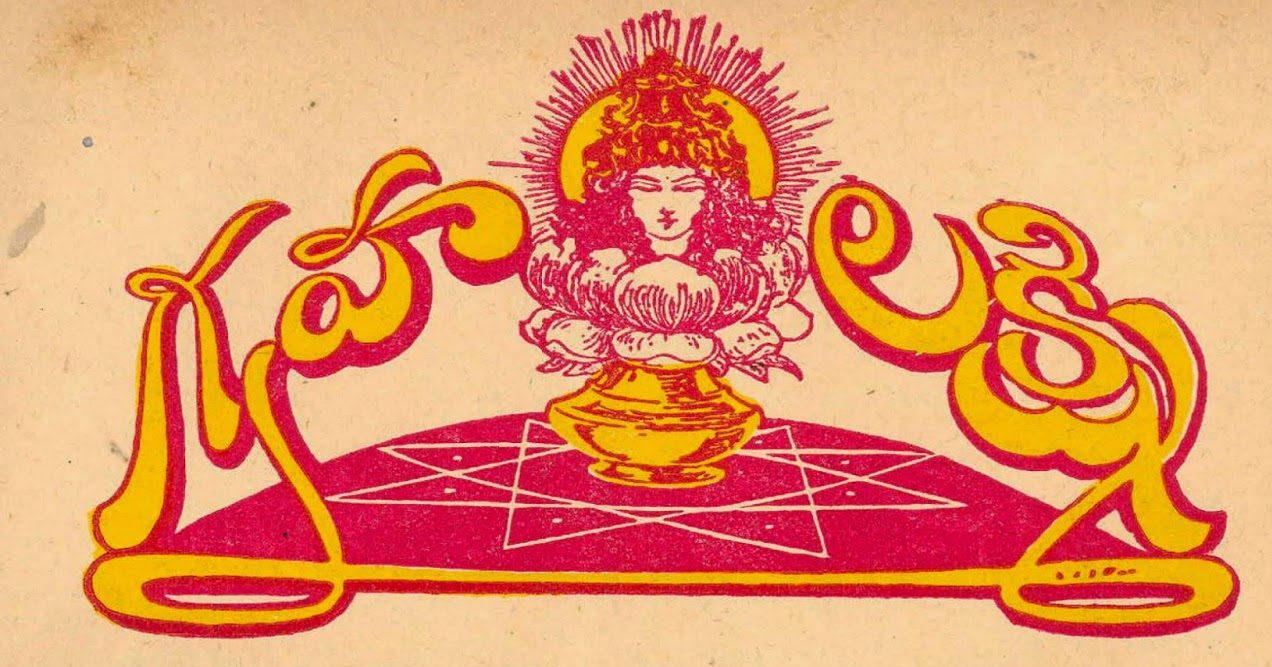
Grihalakshmi, 1929
Suneetha: How did concerns around social reform change with the entry of women? Can you give us an example?
Basha: Let us take the issue of education. Initially, all (both men and women) argued that women needed to be educated. Men wanted better wives, not ‘beasts’ who grew up in the wilderness of ignorance. They wanted women who would not frustrate the Romantic aspirations of their personal lives. Most of these gentlemen had studied Romantic literature in English schools and colleges and found Romantic love utterly lacking in their daily family lives. They also thought wives could support their husbands in with their social activism.
Early women reformers – say for example Bhandaru Atchamamba – also argued that, if educated, they would prove to be better wives, better mothers, better daughters-in-law, better neighbours, etc. Women would become constructive, civilised, and ‘socially useful’ individuals. They would avoid cheap gossip with neighbouring women (poruginti ammalakkalu). So, there was a war cry for women’s education to improve women’s behavior.
Once the need for women’s education became generally agreed on, pro-women’s education people started debating the kind of education women should receive. They discussed whether the curriculum of boys and girls should be the same and whether women should aspire for higher education, etc. While it is difficult to say with precision, it may be said that this discussion largely started in the second decade of the twentieth century.
But it was not until the forties that some writers started regularly arguing that one’s choice, not one’s gender, should determine educational tracks: if a boy wanted to choose cooking as his profession, he should have the choice to get the kind of education required for the job; similarly, if a girl wanted to join the army, she should have the choice to receive suitable education.
Suneetha: When did women writers, activists, and reformers begin to question social double standards and male dominance?
Basha: By the 1920s, women had begun to boldly accuse men. They held them responsible for their dismal conditions. Most importantly, they demanded that men must become patnivratas (devoted to wives).
Women intellectuals like Chimakurti Satyavati Devi said that men have always tutored women to become pativratas (devotees of husbands) and published a large number of books, including ‘canonical texts.’ She forcefully argued that now it was the time for men to become patnivratas.
In 1929, a feminist named V. Saraswati demanded that men grant ‘freedom’ to women. She wrote: “Is it not strange that Indian men, who are fighting for freedom from the British, are not willing to grant the same to women, who constitute 50% of the Indian population?”
She believed that Indian men should give full freedom to Indian women before asking for the same from the British. She cursed them saying that if men did not do that, they would never get freedom. At another place, while she was engaged in a debate with Bangalore Nagarathnamma, V. Saraswati declared that ‘Indian men, or for that matter, all men in the world were selfish’.
Like this, one finds women discussing a number of issues in women’s journals: not just their civil and political rights but also their social conditions – the ‘energy-sapping’ kitchen, ‘thankless’ domestic labour (often described as vetti i.e. customary forced labor), the burden of childrearing falling solely on women, and husbands who were insensitive, cigarette-smoking, and money-wasting etc.
Grihalakshmi , 1929
Suneetha: So, women moved from being the object of male benefaction to having their own voice in the 1920s?
Basha: The issue of husbands giving ‘salaries’ to their wives was discussed in the late 1930s. As we know, in 2012, the Ministry of Women and Child Welfare, Government of India, seriously considered this plan as a marker of recognition to women’s domestic labour.
Yellapragada Sitakumari rubbished such plans to be the ‘conspiracy of men.’ She asked many apposite questions: who would give salaries to single, separated, and widowed women? It was possible for an employee to change her employer if she was not satisfied with her salary offered or continue in a job. ‘But could a wife change her husband if she was not satisfied with the salary he offered or if she did not like him?’ Sitakumari asked these questions when the notion of divorce for Hindu women was still in its infancy.
Similarly, one comes across short stories such as ‘Vanta Yevaru Cheyyali?’ (‘Who Should Cook?’) by Sarojini Devi. ‘Godraalu’ (Infertile Woman) is a powerful short story that questions deep-seated stereotypes with regard to women and motherhood.
Suneetha: How does caste appear in these journals and the social reform organizations that published them?
Basha: Caste appears very clearly. The women’s journals I studied are openly ‘upper’ caste-oriented in character. They were particularly dominated by Brahmin women. Almost all the editors of the women’s journals belong to the Brahmin caste. Most of the contributors, especially in the initial phase, were also ‘pure vegetarian’ Brahmins.
A number of non-Brahmin women also contributed to the journals although their number was less. Within the non-Brahmin segment, Vaishya women had a stronger presence followed by Kammas and Reddys. There were very few Dalit women. The women’s journals did feature Dalit women who accomplished something in terms of education and public life. In Vivekavathi, one comes across a number of Christian women writers but I cannot confirm they are Dalit Christians.
At least a few of the ‘progressive’ upper caste women used caste status to threaten their caste-women. For example, when they wanted to convince them about the importance of women’s education, they usually pointed to the Christian (including Dalit Christian) and Shudra women, who passed higher examinations, and threatened that if ‘our Brahmin’ girls, who possessed superior mental faculties, did not study, they would lag behind their social inferiors. Thus, the fear of losing status was successfully injected and a kind of caste-competition was promoted.
There were a few women’s organisations like the Sri Vidyarthini Samajamu (Kakinada) mentioned above that explicitly excluded members by caste. Its bylaws debarred Dalit women from becoming members. At the same time, we see that this caste arrogance did not go unquestioned, especially by Shudra women like Kalagara Pichchamma and Kalagara Ramamma.
Suneetha: In the light of these caste dynamics, do you think the social reform initiatives promoted in women’s magazines have a relevance for the broader public? Or are they simply limited to some groups?
Basha: The education campaign that Telugu women launched was for all women. They campaigned against child marriage practised by all castes (in varying degrees), including Shudras and Dalits.
Even before Gandhi’s appeal for a humane treatment of the Dalits, Telugu women’s journals tried to sensitise society towards the problems of ‘untouchables.’ This is why we regularly find articles by upper caste women condemning untouchability. Yet, most of them also felt that treating Dalits with respect or allowing them to draw water from their wells was some kind of charity. In this regard, the language of rights had yet to enter their minds.
Suneetha: There is a popular idea that Hindus welcomed social reforms while Muslims remained conservative. Does your study of Telugu women’s magazines give us any clarity about this?
Basha: This is difficult to answer based on my study. I could find only a negligible number of Muslims in Telugu women’s journals. Interestingly, I did find many male Muslim names in the subscribers’ lists.
I discovered a short story by S.M. Akbar that criticized the practice of Burqa/Purdah. This was published in Grihalakshmi in the 1930s. I take this to mean that if there were people who wanted to discuss Muslim issues, Telugu women’s journals welcomed them.
There were a few other Muslim women and men who occasionally appeared in their pages – S. Nanni Begum, Saleema Begum, etc. The latter, based in Madanapalli in Rayalaseema, was active in the women’s movement.
Suneetha: One striking feature about your book is that it breaks the invisible line of 1947. Historians take this as a sacrosanct boundary – most research focus either before or after Indian independence. Why did you think it was necessary for your history to bridge the colonial and post-colonial periods?
Basha: Women’s journals show us that many women shared a perception that men might cheat them out of the fruits of their joint struggle for independence. This perception only became stronger after 1947.
It was believed that something very big would take place after independence. Many women were disappointed to find that that these ‘big’ things were nowhere to be seen in Government policy or even society at large.
So, women naturally felt that the social reform movement, under their own leadership, must continue. As per available evidence, we find that it continued well beyond the ‘magical’ boundary of 15 August 1947. There was still much work to do.
Share this:
Like this: